Showing posts with label History. Show all posts

A History of the Mountain Province by Howard T. Fry

A History of the Mountain Province is a nonfiction / history book written by Howard T. Fry

About the Book / Synopsis / Preface

In this book, the history of the Mountain Province is seen to fall into three distinct periods. In the first of these, when the Republican Party controlled the Presidency of the United States, the emphasis was upon creating a form of mountain reservation for the "non-Christian tribes" of the Cordillera Central. After a series of adventurous expeditions had been undertaken in order to define the ethnology of the region, policy was directed toward developing roads and trails whereby to put an end to the intertribal feuding and headhunting, thus laying the foundations for the future civilization of these "wild men", as Dean C. Worcester was in the habit of describing these mountain peoples. This policy of creating mountain reservation inevitably lent itself to "divide and rule" tactics on the part of the imperial power. The second period was inaugurated by the incoming Democrats in 1913, when the idea of separating the mountain peoples from their lowland Christian neighbors was abandoned in favor of a policy aimed at achieving their integration in the body politic of the Philippine nation, and the emphasis shifted from the building of roads and trails to the provision of better and more widespread health and educational facilities. The third period, hastened by the events of the Second World War, saw the mountain peoples taking over the local control of their own affairs.

Throughout these three periods of political growth there has been a continuing search for the best means of achieving the economic growth of the region, both to enable the growing population to be fed, and to allow these mountain peoples to escape from the abject poverty which is the main barrier to their further advance in civilization. Increased food production has been sought through expansion into hitherto unsettled areas, in conjunction with the introduction of more efficient and scientific farming techniques. The search for the best means whereby to generate greater income has been a recurring quest for promising new marketable crops, with reiterated calls, over the years, for a revival of the coffee industry, and for perseverance in the attempts to develop a silk industry. As the mining industry has developed, so there have been calls for realizing the hydro-electric potentialities of these mountains, thus paving the way for the establishment of further industries, which in turn will provide more jobs for the local people. For present and future reference it has seemed worthwhile to record these various ideas and plans in some detail, as the problem is a continuing one, and it is wise to pay heed to what has been suggested and tried in the past.

In the preparation of this work I have been unable to trace one major primary source. With the enactment of the Jones Law in 1916, the system of submitting the reports of the Governors and Deputy Governors of the Mountain Province and its subprovinces clearly changed, and apart from a number of the reports of Governor Dosser, preserved in the Hayden papers, I have been unable to locate these reports after 1916. I am told that this disappearance of the provincial governors' reports after 1916 is not confined to the Mountain Province, and the fact is mentioned here in the hope that it may bring to light more information on this problem, or prompt a further research for this important series of missing documents.

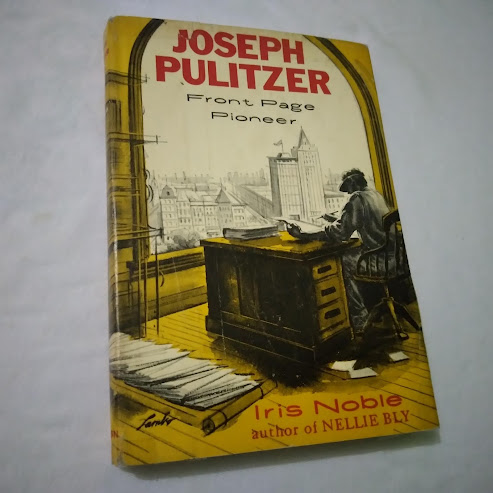
Joseph Pulitzer: Front Page Pioneer by Iris Noble

 Like a fiery comet Joseph Pulitzer rocketed across the American Newspaper world and changed the course of its history. Reporter, editor, publisher, he became the nation's greatest crusader against corruption, fought for and won our freedom of the press.

At seventeen, Joseph Pulitzer, a Hungarian immigrant, arrived in New York without money, without friends and without even a knowledge of English - he had come to join the Union Army to fight slavery. After the war he tried unsuccessfully to get a job in New York and then hitchhiked to St. Louis where he became a mule hostler, stevedore, waiter, messenger boy - anything to support himself while he studied for the law examinations which he passed at twenty-one.

Impressed by the young man's brilliance and determination, Carl Schurz, owner of the St. Louis Westliche Post, hired him as a reporter. Pulitzer's crisp, hard-hitting prose set a new style in news writing, and his insistence on unbiased reporting startled his employer as much as the city itself. As a gag his fellow reporters named him to run as a Republican state candidate in a Democratic district. He won, and what he learned in this battle sustained his headlong, never-satisfied search for the news behind the news.

He bought the run-down Post for its AP franchise, merged it with the Dispatch and created one of the strongest independent papers in the country. Leaving the St. Louis Post-Dispatch in charge of his competent editor, he moved his family to New York where he bought The World. After only two years he surpassed the circulations of the mighty Times, Tribune, Herald, and Sun

Always there was the thrill of exposes, scoops, the flogging passion for truthful, unprejudiced news reporting, a policy of responsibility to the readers. And then at the height of his success, and still a young man, came overwhelming tragedy - he faced total blindness.

This is the dramatic story of an idealistic genius who shaped the pattern of present day journalism and who left a legacy to the journalists of tomorrow in the famous Pulitzer Prize Awards.

Joseph Pulitzer: Front Page Pioneer by Iris Noble

Erwin Tulfo's Facebook Comments About Critics Of Ferdinand Marcos Sr.

The claim: Erwin Tulfo (a Filipino journalist, columnist, television news anchor, and radio commentator) told critics of the late Philippine President Ferdinand Marcos Sr. to stop using infrastructure like bridges, highways, train stations, etc. that were built during the dictator's reign.

False. There's no evidence to show that Erwin Tulfo said it. The quote which went viral on Facebook and other social media sites like Twitter and Instagram originated from a Facebook page called "KUYA Erwin Tol". The page posted the quote on May 15, 2016 and so far it has generated more than 65,000 shares. The page isn't being run by Tulfo. The administrators of the page are still unknown.

The content of the post:
Maraming galit sa mga marcos.
Pero kung galit kayo panindigan nyo galit nyo.
Iboycot nyo mga pagawa ni marcos. Wag kayo dumaan sa SAN JUANICO BRIDGE wag kayo dumaan sa EDSA
Hanap kayo ng ibang airport wag kayo sumakay sa NAIA
wag kayo dumaan sa NLEX
wag kayo dumaan sa SLEX
Umalis kayo sa mga region ng pilipinas (region 1 to 12)
Umalis kayo sa NCR
wag kayo sumakay sa mga train. LRT, MRT, at PNR
wag kayo gumamit ng MERALCO
wag kayo gumamit ng tubig MWSS
wag kayo tumangap ng 13th month pay
at kung galit kayo iboycot nyo lahat ng mga proyekto ni marcos ewan ko lang kung mabuhay pa kayo.
Galit na galit kayo patuloy nyo naman pinapakinabangan ang mga pagawa ni MARCOS.
Diba mga tol.

*This quote is a variation of an arguments claiming that critics of Marcos don't have the right to criticize the late president because they're using the roads/highways/buildings/etc that the president built during his term from 1965 to 1986.
*Dozens of Facebook pages (mostly pages supporting Marcos and Duterte) regurgitated and spread the quote on social media.
From the KUYA Erwin Tol Facebook page.
Originally published: November 13, 2016
Last updated: November 13, 2016

Visitor Guidelines At The National Museum Of The Philippines (Pambansang Museo Ng Pilipinas)

1. The following are not permitted in the exhibition galleries: smoking, food and drinks, touching of museum objects, flash photography, commercial photography, videography, tripods, large bags and carriers, wrapped packages, umbrellas, pens and art materials.
2. All persons and items are subject to security inspection.
3. The National Museum reserves the right to refuse entry to any person.
4. The National Museum reserves the right to refuse to check any item.
5. The National Museum is not responsible for any items lost, damaged or unclaimed.
6. Food, drinks and any organic material may not be deposited in the checkroom.
7. Public facilities are for museum patrons only.
8. Disabled access - the museum is accessible for those who are mobility impaired. However, wheelchair use is restricted in certain exhibitions due to space limitations. Special arrangements can be made for those with other disabilities.
9. Our guidelines help protect the national collections and ensure a safe and enjoyable experience for all. Thank you for your consideration.
10. All visitors are required to sign in the visitor's logbook before they are allowed to view the exhibits inside the museum.
11. If you are planning a group tour, you must book the tour in advance. Get in touch with the Museum Education Division for your reservation. Also, group tours are not allowed in the museum on Sundays.
12. Buses carrying groups of visitors should park outside the Museum of the Filipino People.
13. Drop-off point for groups is outside the National Museum gate which is located along Padre Burgos Avenue and Finance Road. Visitors are requested to leave their bags, food, drinks, and other items inside their buses.
14. The coordinator or leader of the group tour should pay the entrance fees as well as fill up the visitor's logbook before the group will be allowed to enter the premises.

Jack London Trivia: Well-Known Author Of The Call Of The Wild

Jack London is a literary hero and legend. Although most of his works were published more than a century ago, he still remains as one of the most recognizable names in the literary world today. His writings never wavered in their popularity as the decades went by. The man and his works are as popular today as they were popular over a century ago.

He became world famous in 1903 when his book The Call of the Wild was published. This was the book that made London a household name. This book was also his ticket to becoming the first writer to earn a million dollars from his writings.

Most people only know London as the author of The Call of the Wild but the fact is he had written dozens of works. And these are all great pieces of writing that fans of the written word should read.

Here are some Jack London trivia to help you learn more about the legendary writer:
1. His real name is John Griffith London but he preferred to be called Jack and this is the name he used in all of his published works. He also wanted to be called Wolf.
2. His real father has never been definitely established. Some say his father was William Henry Chaney, an astrologer who lived with Jack's mother Flora Wellman in 1875. Jack was born on January 12, 1876. On the other hand, some say that Jack's father was John London, a man married by Flora nine months after the birth of Jack.
3. Jack's family was very poor so he was often put to work as the breadwinner of the family. He was working even before he finished grade school. He held jobs that included selling newspapers at the Oakland water front, scrubbing the floors of dirty saloons, setting bowling pins in bowling alleys and working in a cannery for twelve hours a day. In his later years, London described his childhood as "my life has been one of toil".
4. Typhoon Off the Coast of Japan, one of London's first published works was a product of his adventures as a sailor aboard the Sophie Sutherland, a sealing schooner that operated in Japan and in the Bering Sea. London joined the schooner's crew when he was just seventeen years old.
5. As a teenager, London worked as a fish patrolman as well as a pirate in the San Francisco Bay. He bought a sloop with the three hundred dollars he borrowed from a certain Jennie Prentiss, his former wet-nurse.
6. He once served a prison term at the Erie County Penitentiary for vagrancy. This happened after his return from the sea as part of the Sophie Sutherland crew.
7. London easily passed the entrance examinations at the University of California in 1896 after extensive cramming. He however dropped out after just one semester because he can no longer afford the university fees.
8. London died on November 22, 1916 at the age of 40, just less than a year before the United States entered World war I.
9. London's most popular works are his books about the North collectively known as the Northland Saga. These include The Call of the Wild, The Son of the Wolf, A Daughter of the Snows, The Faith of Men, Lost Face, Scorn of Women, and Smoke Bellew.
10. London's other major works include The People of the Abyss, The Iron Heel, When God Laughs, The Valley of the Moon, The Star Rover and The Assassination Bureau Ltd.


If you haven't read any of Jack London's writings and you don't know where to start, it's recommended that you begin reading the collection titled Great Short Works of Jack London which was first published in 1965 by Harper & Row. The book contains the stories The Call of the Wild, White Fang, Batard, To Build a Fire, In a Far Country, The Law of Life, Love of Life, and An Odyssey of the North.

Stannis Baratheon's Armor Was Inspired By Armor Worn By The Moro People Of The Philippines

If you are a Filipino and you are a huge fan of the HBO series Game of Thrones, then you are going to love this interesting bit of information about Stannis Baratheon's armor. We have reasons to believe that the Lord of Dragonstone's armor was inspired by armor that used to be worn by the Moro people in the Philippines. If you look closely into the details and patterns of Baratheon's armor and compare it with a Moro armor, it's not that hard to see the uncanny similarities.

These similarities were first observed by Matt Easton, a martial arts teacher and arms and armor researcher from London, England. Easton also runs Schola Gladiatoria, a historical European martial arts group. Easton has a YouTube channel where he uploads videos wherein he talks about historical martial arts, military history, antique arms and armor, basically anything that has something to do with combat.

In one of his videos, Easton discussed Baratheon's armor and made the assertion that it was directly inspired by the design of armors worn by the Moro people in Southern Mindanao. And if you are to compare the two armors, Easton may be up to something. The armors do look alike. The patterns are too similar to each other to be brushed away as a mere coincidence.

There's only one way to confirm that Baratheon's armor was indeed inspired by Moro armor. And that is to get hold of Game of Thrones's costume design team and ask them where they got the inspiration for Baratheon's armor. Sadly, we don't have that power. But based on Easton's observations and the photos below, it's very likely that Baratheon is indeed dressed in Moro-inspired armor.


Noli Me Tangere Chapter 2 Summary

Long summary:
Captain Tiago, the host of the evening party, enters the living room with Don Crisostomo Ibarra. Tiago introduces Ibarra as the son of his deceased friend. He also tells the group that Ibarra just arrived from Europe.

Father Damaso is petrified by the entrance and appearance of Ibarra. When the latter introduces himself to the priest and alludes to a friendship between the priest and his late father, the priest responded by saying "your father was never a close friend of mine".

Ibarra immediately withdraws the hand that he extended towards Father Damaso. In that instant, the Teniente asks Ibarra if he is the son of Don Rafael Ibarra. The young man acknowledged the question.

The Teniente tells the young Ibarra that he met and knew his father and that he was one of the country's most honorable men. Ibarra replied by thanking him and hinting that he doesn't know what caused his father's death. The Teniente gets emotional and hurries to leave.

Ibarra introduces himself to a group of ladies but he generated no response so he leaves and joins a group of young men instead.

A man approaches Ibarra and introduces himself as Captain Tinong of Tondo. Tinong invites Ibarra for lunch at his house in Tondo but the latter politely declines saying he is leaving for San Diego first thing in the morning.

An attendant informs everyone at the party that dinner has been served. The guests start proceeding towards the dining hall.

Short summary:
Captain Tiago appears at the party with Crisostomo Ibarra whom he starts introducing to some guests. Father Damaso isn't too happy about the young Ibarra's presence in the gathering. In a conversation with the Teniente, Ibarra hints that he is still in the dark with regards to what has befallen his father, the late Don Rafael Ibarra.

5 Extinct Animals That Used To Live And Roam In The Philippines

The Philippines can be considered rich when it comes to ecosystem variety. After all, it has forests and seas teeming with life. However, the country is rather lacking when it comes to large beasts like the bears of North America, the elephants of Africa, or the tigers in other Southeast Asian nations.

However, science tells us that this was not the case in the past. If you are to go back thousands or even millions of years back, the Philippines was actually home to creatures like gigantic elephant-like mammals, ancient manatees and rhinoceroses. Fossils dug up from various sites in the country provide us a picture of what types of animals roamed the archipelago in the distant past. Below are five of such animals.

1) Stegodon - At first glance, they look like woolly mammoths without the wool. Or modern elephants without the gigantic tusks. However, science tells us that they are neither because stegodons went extinct thousands of years ago. The last of them are believed to have died out near the end of the Pleistocene era.

Early scientists had the theory that stegodons may have been the ancestors of modern elephants. However, evidence that have been gathered through the years disprove this theory. Thus the current consensus that stegodons have no modern descendants.

Stegodons used to roam in large parts of Asia and East and Central Africa. The beasts can grow up to 15 feet high and 30 feet long. Fossils of them have been found in Asian countries like China, Indonesia, Thailand, Taiwan, Japan, and of course the Philippines. A molar of the animal was found in the province of Kalinga in 1973. Fossils of the stegodon were also found in Mindanao.

Below is a life-sized model of a stegodon. Note that it looks like a cross between a woolly mammoth and a modern elephant.
Source: Wikimedia Commons
2) Philippine Rhinoceros - It's interesting to think that these horned animals used to roam in the forests of the Philippines. Sadly, they haven't been around for thousands of years and all we have to prove that they once lived within our shores is a single fossil dug out from Pleistocene sediments in Fort Bonifacio in 1965. The fossil was that of a portion of the animal's right upper jaw with two intact molars and a broken one.

Very little is known about the Philippine Rhinoceros because a full skeleton of it is yet to be found. Aside from the fossilized jaw bone and the estimate that it went extinct during the Pleistocene era, there's no other information available about it.

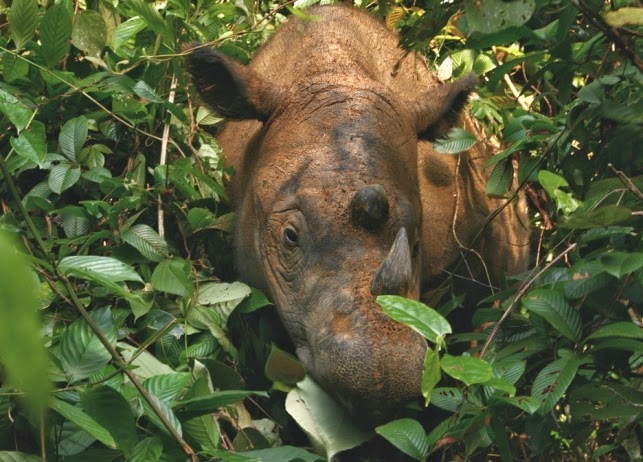
But if you want to get an idea of what it would've looked like back then, below is a photo of a living Sumatran rhino. Sumatran rhinos are cousins of the Philippine rhino. The latter are believed to be larger than their Sumatran counterparts.
A Sumatran rhino. Source: Wikimedia Commons
3) Cebu Warty Pig - This particular pig has the distinction of having been declared extinct in modern times. It was assessed as extinct in 2000 which is less than two decades ago. The culprit? Humans of course. Cebu warty pigs went kaput because of two main reasons. One, they were hunted down for food. And two, their habitat were destroyed.

The Cebu warty pig is a subspecies of the Visayan warty pig which in itself is also critically endangered. A very small number of them remains in the wild. Some of them are being kept in captivity which in a way stirs up hope that it will be much harder for them to go extinct.

Below is a photo of the Visayan warty pig. It's very closely related to the now extinct Cebu warty pig so they pretty much looks the same. Look at it closely because who knows, it might be gone in the next decade or so. Hopefully, it wont.
A Visayan warty pig. Source: Mike Peel via Wikipedia Commons.
4) Sirenia Sea Cow - In 2011, a team of scientists from the University of Florence in Italy found the fossilized remains of a sea cow inside the Puerto Princesa Underground River in Palawan. Fossilized ribs and sections of a spine were found embedded in a rock wall.

Leonardo Piccini, an Italian geologist who was part of the expedition said that the fossil dates back to the Miocene era which is about 20 million years ago. Study of the fossilized bones showed that they belonged to an extinct species of plant-eating sirenia or sea cows.

There are two species of sea cows that are in existence today. These are the dugongs and the manatees. The fossil found in the underground river in Palawan is the first of its kind ever found in the Philippines. Other similar fossils were found in Java, Sri Lanka, and Pakistan.
A photo of the fossils found embedded in the walls of an underground river in Palawan. Source: KJ Rosales via The Archaeology News Network.
5) Dwarf Buffalo - Some people are often humored when they see the rather small size of the tamaraw water buffalo which can be found in Mindoro. Well, these people haven't seen nothing yet.  A set of fossils found in Cebu implies that an even smaller species of water buffaloes used to roam in the archipelago.

This extinct species now referred to as either dwarf buffalo or pygmy water buffalo lived between 10,000 and 100,000 years ago. They are quite small in nature. A mature one stands only 2.5 feet and weighs only 350 pounds. That's a pittance if you compare it to the average size and weight of water buffaloes today.

To give you an idea of how small the pygmy water buffalo was, below is an illustration comparing it to the modern water buffalo and an average-sized human being. Neat, isn't it? The animal looks more like a dog than a carabao.
Source: Discovering Archaeology via Wikimedia Commons.

We're pretty sure that there are other extinct animals out there that used to roam in the Philippines. There are fossils out there that are yet to be found by archaeologists and paleontologists. We are looking forward to the days when these fossils are discovered and announced to the public. Until then, let us think in wonder to the fact that we are trudging on grounds that used to catch the footsteps of extinct elephants, rhinoceroses, and mini-carabaos.

6 Myths, Rumors, And Untruths About Jose Rizal, The National Hero Of The Philippines

"Ang hindi magmahal sa sariling wika, daig pa ang hayop at malansang isda." This is a quote often attributed to Jose Rizal, the national hero of the Philippines. It's a line from the poem Sa Aking Mga Kababata which is being taught in schools all over the archipelago as a piece written by the celebrated hero when he was just 8 years old.

However, there's very little evidence proving that Rizal wrote the poem. In fact, evidence shows that he didn't pen it. In his book Rizal Without the Overcoat, historian and essayist Ambeth Ocampo made a convincing case that the poem was written by someone not named Jose Rizal. This and other myths, Jose Rizal rumours, and untruths about the national hero are discussed below.

1) Rizal is the father of Adolf Hitler.
If you put alongside each other photos of Rizal and Hitler, it's not that difficult to see bits of resemblance. They're both small of stature. They have dark hair and dark eyes. Rizal also did a stint studying at the Heidelberg University in Germany. Maximo Viola, a friend of Rizal, once wrote about an encounter between Rizal and an Austrian woman and theorists claim that their union may have produced Hitler. These are just some of the instances that are causing people to believe that Rizal fathered Hitler.

However, as Ambeth Ocampo pointed out in his book Rizal Without the Overcoat, Hitler was born in 1889 and Rizal left Germany for good in 1887. Babies are born only 9 months after conception. You do the math.

2) Rizal is the dreaded Jack the Ripper.
Source: thedungeons.com
Rizal was in London from May 1888 to January 1889. Jack the Ripper was planting fear and havoc in the streets of London around this time. According to believers of the connection between the two, the killings suddenly stopped when Rizal left the city.

Furthermore, Jack the Ripper is known for his surgical precision in murdering his victims which suggested that he had medical training. It so happened that Rizal was a doctor. Also, Jose Rizal's initials J.R. match those of Jack the Ripper. But, aside from these dismissible evidence, there's absolutely no reason to believe that Rizal was the Ripper.

3) Rizal wrote the poem Sa Aking Mga Kababata when he was eight years old.
Filipino students are being taught that Rizal wrote the poem in Calamba when he was merely eight years old. However, there is enough evidence to suggest that this is not the case. The poem was first published 10 years after Rizal's execution. Herminigildo Cruz, the man who published the poem said he got it from a certain Gabriel Beato Francisco who in turn got the poem from a certain Saturnino Raselis. Raselis allegedly received the poem from Rizal himself. This claim has been completely debunked by Ambeth Ocampo in his essay Rizal Did Not Write Sa Aking Mga Kabata.

In Ocampo's words, "No original manuscript, in Rizal's own hand, exists for "Sa Aking Mga Kabata" traditionally believed to be his first poem. Rizal had 35 years to publish or assert authorship but he did not." A popular quote from the poem in question goes, "Ang hindi marunong magmahal sa sariling wika, masahol pa sa hayop at malansang isda." Well, based on evidence, it's highly unlikely that Rizal ever said this.

4) Rizal is alive and divine.
Source: faithology.com
There are people who believe that Rizal is alive and well. Majority of these people are members of the Rizalista movement, a religious group who believes that Rizal has turned divine and would come in glory to the Philippines after the end of the world. Why do these people think that Rizal is alive? It seems that they took their cues from a report written by an agent of the Spanish governor-general three months after Rizal's execution.

According to the report, soldiers who loaded Rizal's body into a carriage, upon reaching the gates of the cemetery, discovered that the body has disappeared. Even more unbelievable, there was reportedly a white cock that has taken the place of Rizal's body. These were all nothing but rumors of course.

5) Rizal is a psychic and has prophetic abilities.
Source: filipiknow.net
The irony of this myth is that it grew because of the writings of Ambeth Ocampo, the go-to guy when it comes to topics related to Rizal. It's ironic because Ocampo has debunked a lot of the myths and misconceptions about Rizal, yet he is the culprit when it comes to the growing popularity of the suggestion that Rizal has psychic powers. Although Ocampo has taken his cues from the writings of Austin Coates, Leon Ma. Guerrero, and Guillermo Tolentino with regards to Rizal's psychic powers, his own writings are the ones that are most accessible to people. So it was Ocampo who propagated to the greater public the myth that Rizal is a psychic.

The growth of the myth aside, is there evidence to suggest that Rizal is a psychic? There's absolutely none. If you are to look into the writings of Ocampo, Coates, Guerrero and Tolentino that allude to such psychic gifts, these can be satisfactorily explained by good reasoning and logic without having to bring out the psychic card.

6) Rizal wrote his famous poem Ultimo Adios on the eve of his execution.
Source: Wikimedia Commons.
Students in the country are often taught that the night before he was executed, Rizal penned his masterful poem Ultimo Adios. Although this sounds very dramatic, it's simply difficult to believe because Rizal couldn't have written the poem on the night before he was shot. According to the account being taught in schools, Rizal handed the poem to his sister Trinidad on the day before he was executed.

If Rizal gave the poem to Trinidad on December 29, how could he have written it on the eve of his execution. The most logical explanation is that Rizal wrote the poem much earlier than the night of December 29. Rizal scholar Ambeth Ocampo doubts the popular account. So does Gregorio C. Brillantes, N.V.M. Gonzales, Austin Craig, Jaime C. de Veyra and Nick Joaquin.

These myths and rumors about Jose Rizal will likely continue to circulate in the coming years. Hopefully, this article will help in dispelling such misleading claims. If you have anything to add to what we discussed above, feel free to leave your comments, reactions, and suggestions in the comments section below.

A Lesson On The Brief History Of Religion In Art

Jeremiah Dickey has created for TED-Ed this short but interesting lesson about the history of religion in art. Description for the lesson goes "Before we began putting art into museums, art mostly served as the visual counterpart to religious stories. Are these theological paintings, sculptures, textiles and illuminations from centuries ago still relevant to us? Jeremiah Dickey describes the evolution of art in the public eye and explains how the modern viewer can see the history of art as an ongoing global conversation." For discussions and related resources on the lesson, go here to view the whole lesson.

Century-Old Newspaper Filled With News On Titanic Catastrophe Found In Basement

BOB4xF3TT via Imgur
An edition of the newspaper The Chattanooga News dated April 16, 1912 with stories about the sinking of the Titanic in the frontpage was found by a man while cleaning out his grandmother's basement. The RMS Titanic sank in the early morning of April 15, 1912 after smashing into an iceberg in the North Atlantic Ocean during its maiden voyage.

The paper which cost two cents back then contained several headlines for stories about the catastrophic sinking of the RMS Titanic. These were:
1) Over Thirteen Hundred Perish In Titanic Steamship Catastrophe
2) Survivors Of Disaster Aboard The Carpathia: About Eight Hundred Believed To Be All Saved Aboard The Giant Liner
3) Only 868 Survived In Frightful Sea Horror
4) Unwritten Law Of Seas Was Rigidly Enforced: Women And Children, Even In Steerage, First Saved From The Sinking Steamer
5) London Overwhelmed By News Of Disaster
6) Carpathia Believed To Be Only Steamer With Survivors Aboard

The paper which looks to be in great condition is over 102 years old. And given the fact that it covered a huge event in history, it had some people curious if it can fetch a fortune when sold to antique collectors. There are people out there who collect things related to the Titanic. Someone with the username TheKookySpooky who claims to be an antique dealer left a comment on the photo which was posted on Reddit. His comment gives an idea as to how much the old newspaper might fetch among collectors.

Here's TheKookySpooky's comment: "Antique dealer here. There's lots of interest in Titanic collectibles. Lots of things worth lots of money. Newspapers from that era can be worth as little as $5 and as much as $1000. Depending on city, rarity, condition of the newspaper, and economy, is what determines the value. 2 categories here. Titanic collectibles, and ephemera (paper items) collectibles. Best place to find value would be in to find a person who specializes in those."

How A Filipina Mestiza Looked In The 1870's (Photo)

Have you ever wondered how a Filipina mestiza would've looked in the 1870's? Well, the photo below could just be it. This stunningly beautiful woman is of Filipino and Chinese ancestry. Back then, in the 1870's, she's referred to as a mestizo de sanglay. In today's parlance, she is a tsinita. This particular photo was taken by the photographer Francisco Van Camp circa 1875.


The original photo and a digitally-colored version.


Sources: Wikipedia, Imgur